A marketing plan template is a fill-in document that shows who your customers are, how they will find you, what you will spend and what you will do each week for the next few months.
Most small service businesses market when work is slow. Then work picks up, marketing stops, and a few weeks later it's slow again. A simple plan breaks that cycle: one page that says what you'll do, and a 90-day calendar that keeps you doing it, even in busy weeks.
Key takeaways
- A small business marketing plan fits on one page, plus a 90-day calendar.
- Pick two or three goals you can count, and three or four channels. Not everything.
- Start with the free channels where people already look for you: your Google Business Profile, reviews and referrals.
- Spend 30 minutes a week on it, and update the plan every 90 days.
Download the Free Marketing Plan Template
Want 5 more quick wins like this one, for free? The 5 Quick Wins guide shows you how to stop missing calls, get more reviews and save hours every week.
Get the free guide ↓No email required. The template has four pages:
- Page 1: your one-page plan, ready to fill in.
- Page 2: your 90-day calendar and a 30-minute weekly routine.
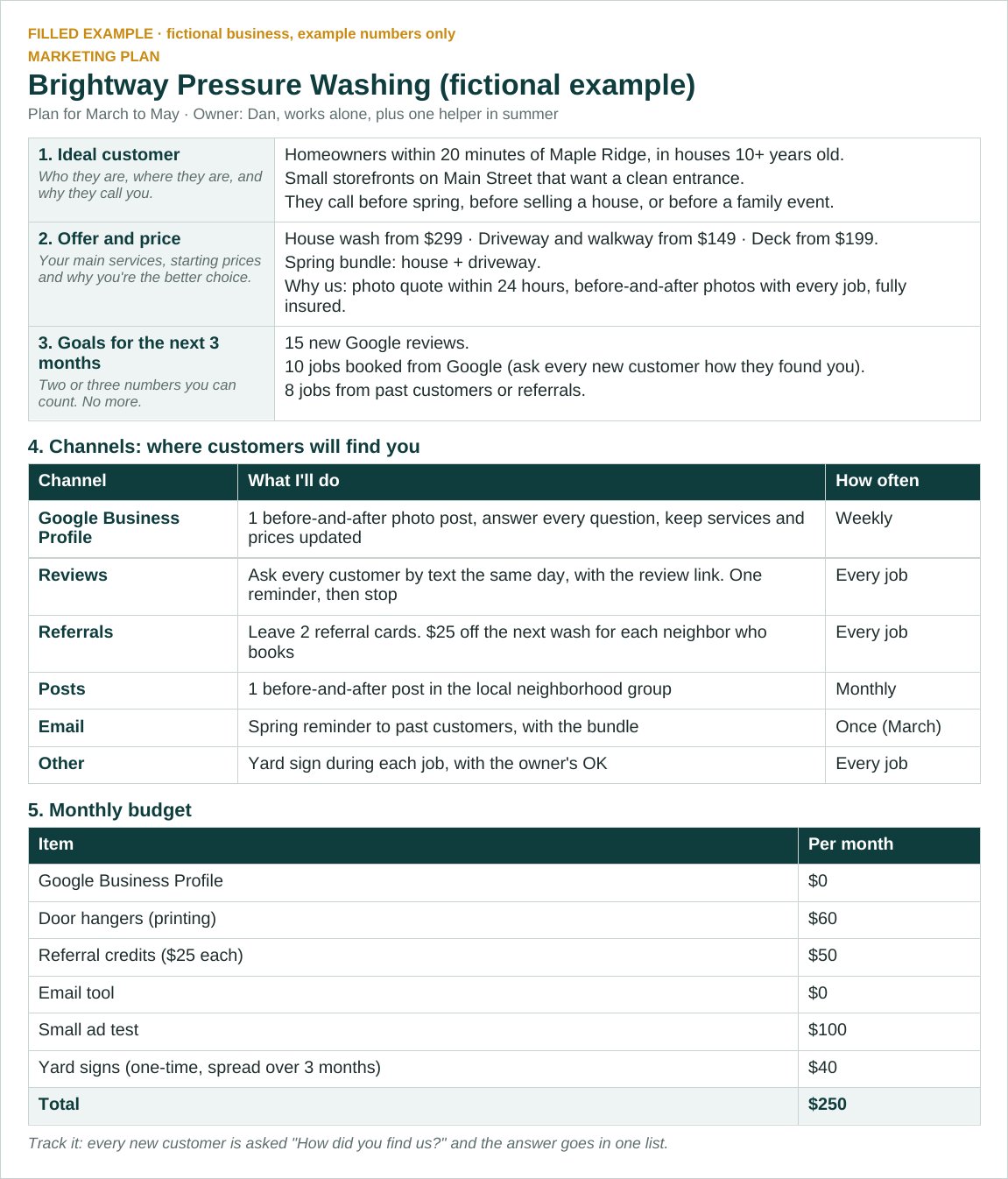
- Pages 3 and 4: the same plan and calendar filled in for a fictional pressure washing business.
What's Inside This Marketing Plan Template
The template follows the same basic parts the U.S. Small Business Administration lists for a marketing plan (target market, competitive advantage, goals, action plan and budget), cut down to what a small service business actually needs:
- Ideal customer: who they are, where they are and why they call you.
- Offer and price: your main services, starting prices and why you're the better choice.
- Goals for the next 3 months: two or three numbers you can count.
- Channels: where customers will find you, what you'll do there and how often.
- Monthly budget: every cost, with a total.
- 90-day calendar: one focus per month, a weekly routine and what to check at the end of each month.
How to Fill In This Template in 5 Steps
Set aside one hour for the first version. You can fill in the plan alone, or talk it through with an AI assistant (there's a prompt below).
1. Describe your ideal customer
Be specific: where they live or work, what kind of property or business they have, and the moment they usually call you. "Homeowners" is too broad. "Homeowners within 20 minutes, in older houses, before spring or before selling" tells you where to show up and what to say.
2. Write your offer and starting prices
List your two or three main services with a starting price, and one line on why someone should choose you: a fast quote, photos of every job, a guarantee, being insured. If you can't say why you're the better choice, your customers can't either.
3. Set two or three goals you can count
Good goals are numbers you can check at the end of the month: new reviews, jobs booked from Google, jobs from past customers or referrals. Avoid goals you can't measure, like "more brand awareness."
4. Choose three or four channels
For most local service businesses, the free channels come first:
- Google Business Profile: where people search for "[service] near me." Keep services, prices, hours and photos up to date.
- Reviews: they help people choose between you and the next business. Here's how to ask customers for reviews, with templates to copy.
- Referrals: your past customers already trust you. Make it easy for them to send a neighbor.
Then add one or two more, like posts in a local group, a seasonal email to past customers or a small ad test. Write down exactly what you'll do in each, and how often.
5. Set your budget and fill in the 90-day calendar
List every cost, even the free ones, and add a total you can keep up for three months. Then give each month one focus, write the weekly routine, and decide what you'll check at the end of each month. Once a month, compare what you spent with your sales in your profit and loss statement.
Marketing Plan Template Example: Brightway Pressure Washing (Fictional)
Here's the template filled in for Brightway Pressure Washing (fictional example). Dan works alone, with one helper in summer, and plans March to May, before his busy season.
| Part of the plan | Brightway's plan |
|---|---|
| Ideal customer | Homeowners within 20 minutes, in houses 10+ years old, plus small storefronts on Main Street |
| Offer and price | House wash from $299, driveway from $149, deck from $199, plus a spring bundle. Photo quote within 24 hours |
| Goals (3 months) | 15 new Google reviews, 10 jobs booked from Google, 8 jobs from past customers or referrals |
| Channels | Google Business Profile (weekly photo post), reviews (every job), referrals (every job), local group post (monthly), spring email (once), yard signs |
| Monthly budget | $250: door hangers, referral credits, a small ad test and yard signs |
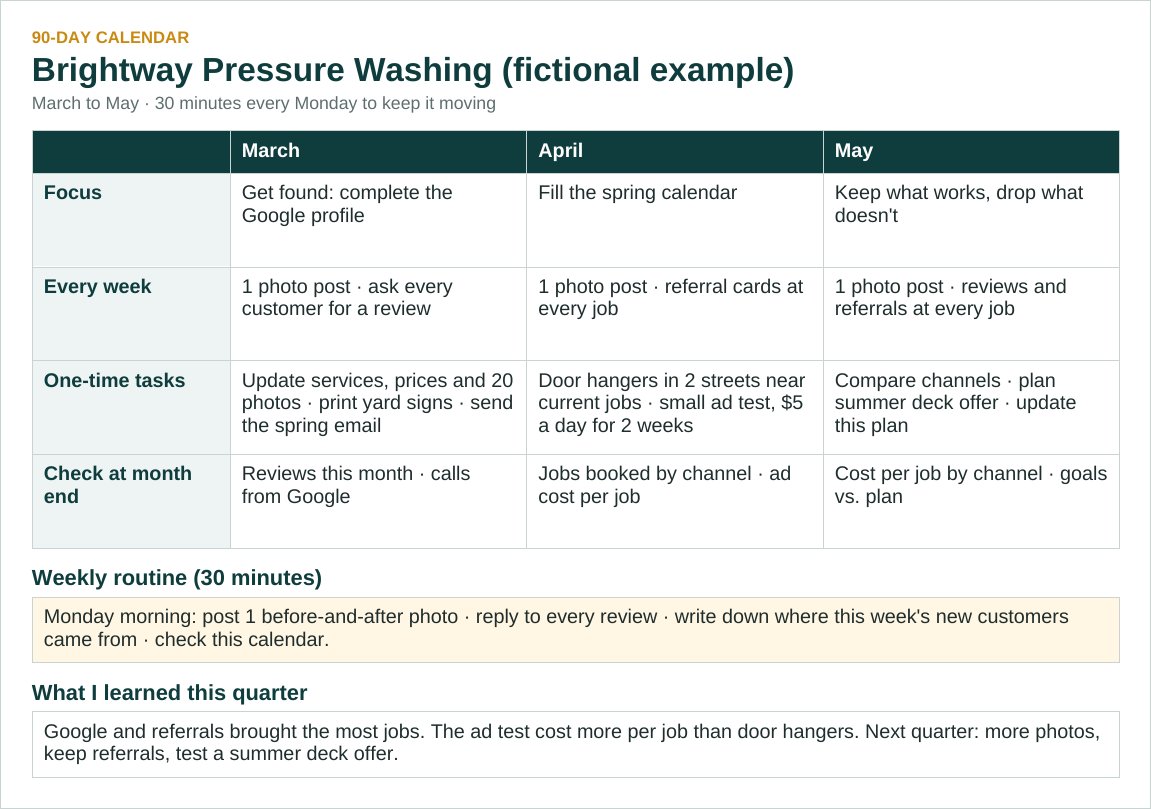
And here's his 90-day calendar:
Notice what makes it work:
- Each month has one focus. March is about being found, April about filling the calendar, May about keeping what worked.
- The weekly routine is small. 30 minutes every Monday, so it survives busy weeks.
- Every new customer is asked "How did you find us?" That one question shows which channels are worth the time and money.
- Reviews are asked from every customer, with no reward attached. The $25 credit is for referrals only, never for reviews.
Which Marketing Channels Work Best for a Local Service Business?
It depends on your trade and your area, but most local service businesses get the most from channels where people are already looking: a complete Google Business Profile, a steady flow of honest reviews and referrals from past customers. Start there, then test one paid channel with a small, fixed budget.
The only way to know what works for you is to track it. Ask every new customer how they found you, write it down, and compare channels at the end of each month. Keep the ones that bring jobs, and drop the ones that don't, even if they feel busy.
Want 5 quick fixes you can set up this week? Get the free 5 Quick Wins guide ↓
Use AI to Build Your Plan in a 10-Minute Conversation
An AI assistant (ChatGPT, Claude, Gemini or Copilot) can turn a short conversation into a first draft of your plan. Paste this prompt and answer its questions:
You are helping me write a simple 90-day marketing plan for my small service business.
Ask me one question at a time, and wait for my answer before the next one. Ask about: my ideal customer, my main services and starting prices, why customers choose me, my goals for the next 3 months, the marketing I already do, and my monthly budget.
After about 10 questions, fill in these 6 parts: ideal customer, offer and price, goals (2 or 3 numbers), channels (what I'll do and how often), monthly budget, and a 90-day calendar with one focus per month.
Keep it short and practical. Do not invent numbers I didn't give you.
Read the draft and change anything that doesn't sound like your business. Don't paste customer names, contact details or bank information into the chat.
Frequently Asked Questions
What should a simple marketing plan include?
Your ideal customer, your offer and starting prices, two or three goals you can count, the channels you'll use and how often, a monthly budget, and a calendar for the next 90 days. Add one habit: ask every new customer how they found you, so you can see what's working.
How long should a small business marketing plan be?
For most small service businesses, one page for the plan and one page for the 90-day calendar. A short plan is one you'll actually read and use. Large companies write long plans because many people work on them. You only need enough to guide your next three months.
How much should a small business spend on marketing?
There's no single right number. Start with an amount you can keep up for three months without stress, put most of your time into free channels like your Google profile, reviews and referrals, and track the cost of each new job by channel. Then move money toward what brings jobs.
How often should I update my marketing plan?
Look at it for a few minutes every week, as part of your 30-minute routine, and update it every 90 days. At the end of each quarter, compare your goals with what happened, drop what didn't work and write the next 90-day calendar.
Not ready for the kit? Get 5 free quick wins.
Five small fixes you can set up this week, with step-by-step walkthroughs and ready-to-copy prompts. Free, by email.
Want Help Running Your Plan Every Week?
This template comes from The AI Marketing Engine, book 3 of the AI for Small Business series: a complete Google Business Profile, a week of posts in one hour, photos and short videos from your phone, a simple monthly email, a steady flow of new reviews and your first small ads. The book comes with the Marketing Planner, a spreadsheet with an idea bank, a content plan, a review request tracker, your numbers and an ad test. It's included in both the Essentials and the Complete Kit (the Google Sheets version comes with the Complete Kit), with a 30-day money-back guarantee.
See the full kit · or start with the free 5 Quick Wins guide